Get a free novella when you subscribe
Forged Wings

AI in Media - How to Handle the Hysterics?

I was recently asked to give a talk on how AI is portrayed in fiction and news media, and as I scanned article after article, one thing became clear: AI algorithms (that is, lines of code) were anthropomorphized to an alarming extent. The systems were always portrayed as more advanced than they were, accompanied by hints about their emergent or unanticipated behaviors (when there were none), concluding with ominous warnings about the threats they posed (even when they didn’t). 

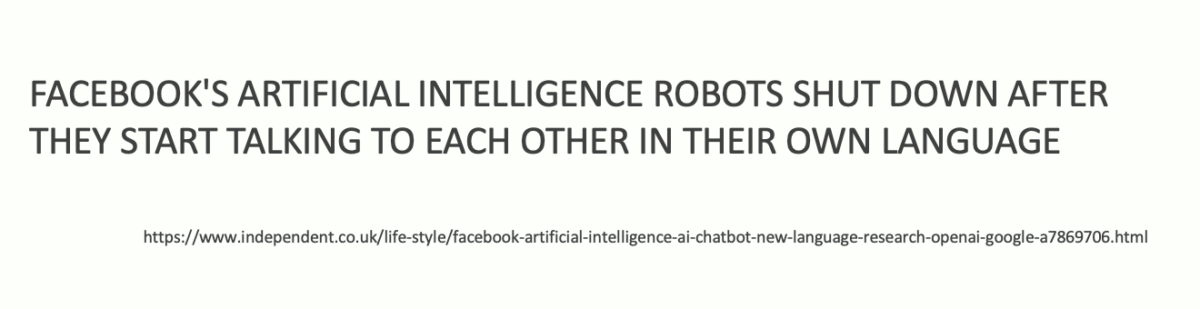
Here is a title (from a few years back) that illustrates this perfectly:
And another outlet’s report on the same project:
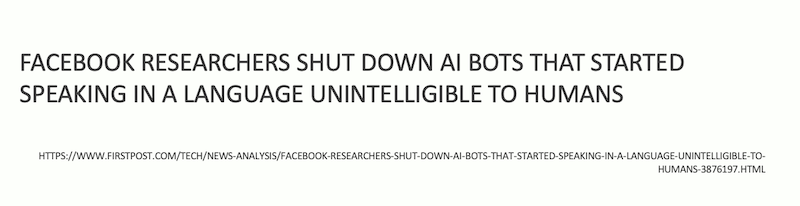
And no, I’m not linking the articles’ URL because that’s the whole point of these titles: they are clickbait. 

Anyway, before we send our thanks to the brave souls who saved us from these dangerous robots in the nick of time, let’s dive into what this project was: it aimed to train chatbots to bargain. 

So, let’s deconstruct this title:
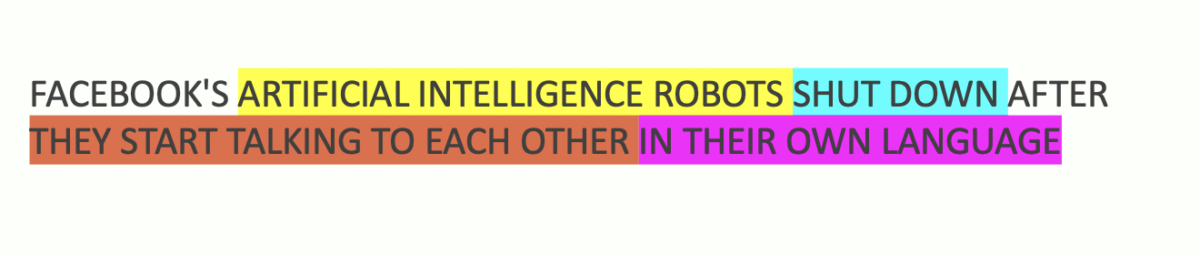
Let’s look at the who, what, and how first:

Who: Artificial Intelligence Robots

Actually, they were chatbots. Already, the title is misleading in that it implies a physical presence that’s not there. 

What: They start talking to each other.

Do you recall they were chatbots? That’s what chatbots do. They talk. So there’s nothing ominous here.

How: In their own language.

Okay, this could be disturbing if it were true, so let’s dig in. But first, a small detour on how most of the AI systems that play games are trained (and yes, bargaining is basically a game). 

Because training an AI system requires to repeatedly show it what is a good move and what isn’t, the process is super data intensive. A neat way to sidestep this problem is to allow the algorithm to play against itself. For example, you can generate a lot of chess games if your chess-playing AI repeatedly plays itself. Called “self-play,” this process allows the system to learn by repeating strings of moves that result in wins and avoiding moves that lead to losses.

In this instance, self-play for chatbots meant they bargained with each other for hats, books, and balls. 

Now remember, the system learns by associating moves (in this case bargaining sentences) to wins and losses. So if a term appears equally in wins and losses, it’s deemed useless. If a term appears in wins, it’s valuable. 

These chatbots realized that wins were associated with multiple bargaining rounds and most bargaining sentences contained simple requests.  For example most sentences had “to me” in them (“give three books to me”). So these “clever” bots figured if “to me” is good to have in consecutive sentences, it must be even better in one sentence to result in requests like:
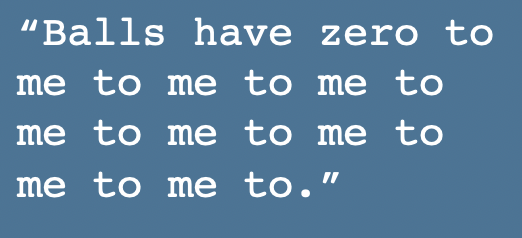
Why did the chatbots do this? First, because the word “value” appeared equally in wins and losses, it didn’t convey any advantage. So they dropped it as a shortcut. But it turned out the words “to me” led to wins so they were repeated in the hope that it would enhance the win likelihood.

I don’t know about you, but as a new and unintelligible language, this is underwhelming. 

The main reason for this of course was that the bargaining self-play was set improperly in that it didn’t require the chatbots to stick to grammatical rules. This is like letting an AI system to learn chess with self-play without providing the rules of the game. If the system learns to pick up a pawn and knock the opponent’s king on the first move, we wouldn’t report it as “Artificial Intelligence Robot discovers stunning new chess move.” We would say someone didn’t do their job right.

With the who, what, how sorted out, we can now focus on the clincher:  they were Shut Down!

This hits us emotionally, implying we dodged one but we may not be so lucky next time. Notice, they never mentioned what would have happened had the chatbots not been shut down, letting our Terminator-tainted brains fill in the gap. 

Spoiler alert, here’s what would have happened: NOTHING.

This entire title (and article) was emotional manipulation, so let’s translate it. When it says: Facebook’s artificial intelligence robots shut down after they start talking to each other in their own language, it actually means:

Now, that’s an accurate title. This said, I’m guessing fewer folks would have clicked on that article, so here we are. 
Severed Roots
Book 3
Severed Roots
The conclusion to the saga that began with Purged Souls, Foreword INDIES Book of the Year Finalist

Former head of Special Forces Lori Rose’s sudden reappearance after a year-long exile threatens the fragile peace Governor Amy Chipps has negotiated with her powerful neighbors. As hostilities intensify, the discovery of an ominous device buried in the unregulated territories shatters the balance of power, sending Amy on the run.

With increasingly powerful quakes foreboding disaster and three armies jostling for control, Amy must reclaim power while Lori must wrest the doomsday device from their enemies. But can they put aside their differences and work together before cataclysmic forces destroy the West Coast?

Forged Wings
Prequel Novella
Forged Wings
A Lori Rose Novella set in the Uregs

A decade after a global virus and the subsequent chaos brought civilization to the brink, Lori Rose joined the military of a nascent matriarchal society to strengthen the rebuilding efforts. But her career stalled because her headstrong personality drew the ire of her superiors. Now, as she contemplates her dwindling options, their enemy launches a sneak attack that kills her command staff and captures hundreds.

But if their enemy wanted a quick victory, they crossed the wrong soldier. With nothing but her wits and a few unlikely allies, Lori hatches a daring rescue attempt against a technologically and numerically superior force.

Can she save her people before her actions plunge them into an unwinnable war?

Forged Wings is a prequel novella that introduces Lt. Lori Rose, before she became the feared General.

Purged Souls
Book 1
Purged Souls
A Foreword INDIES Book of the Year Finalist.

Lori wants to restore order to a world ravaged by virus, violence, and declining birthrates. But the rage that fueled her rise from hungry teenager to Special Forces colonel has left her with few allies. When a mortally-wounded soldier disappears from the hospital amid a cover up, Lori reaches beyond official channels to her only remaining friend, Mika.

Orphaned at eight, Mika lives across a fortified border, away from the spotlight. But he could never say no to Lori, so he gets dragged into a world of secrets and deceit. Together, they uncover a conspiracy that assassinated two heads of state to start a war, all to hide the true nature of the virus that nearly destroyed the human race.

With time running out, Lori has to disobey direct orders and embrace new allegiances to stop the impending coup. The problem is, the rage that powers her also distorts her moral compass—which hasn’t been reliable in the best of times.

Carved Genes
Book 2
Carved Genes
The sequel to the Foreword INDIES Book of the Year Finalist Purged Souls

Mika has a new, near-indestructible body—a side effect of the Purge virus. Yet he broods in obscurity, pushing away everyone, including Amy, the one person who can lift his spirits. But when the Purge starts killing again, twenty years after it vanished, he accepts an open-ended mission and disappears.

Thrust into power amid chaos, Amy struggles to rebuild a world ripped apart by the tension between those who carry the Purge and those who don’t. When a general exploits that rift to grab power, Amy makes a bold decision that antagonizes the leaders of two states.

As victims with Purge symptoms multiply, Mika returns with frightening news about the virus’ variants and origins.  With time running out, Amy must unite the bickering factions to stop the new outbreak from destroying their fragile society. But can she trust Mika again?

You may also like...

“Are you for or against AI?” Though simple, those six words expose the problem we face with our current AI discourse (or almost anything else these days). We’re asked to reduce complex concepts into sound bites and remove all the details that are essential in understanding the issues.

Today, I want to talk about Robot and Frank, one of the most realistic movies about AI and robots you've never heard of. In this underrated gem, an aging burglar receives a robot butler. What can possibly go wrong?

Well, let's dive right in: ChatGPT (which is based on GPT-3, which is based on GPT-2 and so on) is a chatbot from OpenAI that can interact with users and hold a conversation quite naturally. But what does it really do?